The dive watch that chose to look like 1959
Published April 2, 2026
The choice to look sixty years old
You are standing at a counter, looking at two dive watches. One has a flat, perfectly clear crystal, a ceramic bezel, and every modern material the industry has to offer. The other has a domed acrylic crystal that catches light at the edges, gold indices that glow warm against a black dial, and a presence that makes you think of the Mediterranean in 1962. You pick up the second one. Something about it just feels right.
That watch is the Lorier Neptune SIV. Lorier, a small New York brand, looked at what every other manufacturer was doing with sapphire crystal and chose acrylic instead. Not because they could not afford sapphire. Because the dome you can achieve with acrylic sits higher above the dial, catching light the way vintage watch crystals did. Because the people who made professional dive watches in 1959 used acrylic, and the Neptune is trying to look like 1959.
This is a watch built around an aesthetic conviction. The decision to understand that conviction is the first decision you make before you buy it.
New York, small batches, a name
Lorier was founded in New York by Lorenzo Ortega (the brand name is drawn from his own) alongside Rachel Brozenske. They built the Neptune as their flagship: a vintage-inspired dive watch made in small production runs, sold direct, with the kind of attention to detail that only makes sense when you are not making ten thousand units a year.
The Neptune has gone through four series. Each series refined something: case proportions, bracelet construction, crown position, lug length. The SIV has 46mm of lug-to-lug measurement, shorter than any previous version. On a medium wrist, this is the difference between a watch that sits correctly and one that extends past the wrist bones. Lorier spent three versions learning this. The fourth version got it right.
What you get for $599
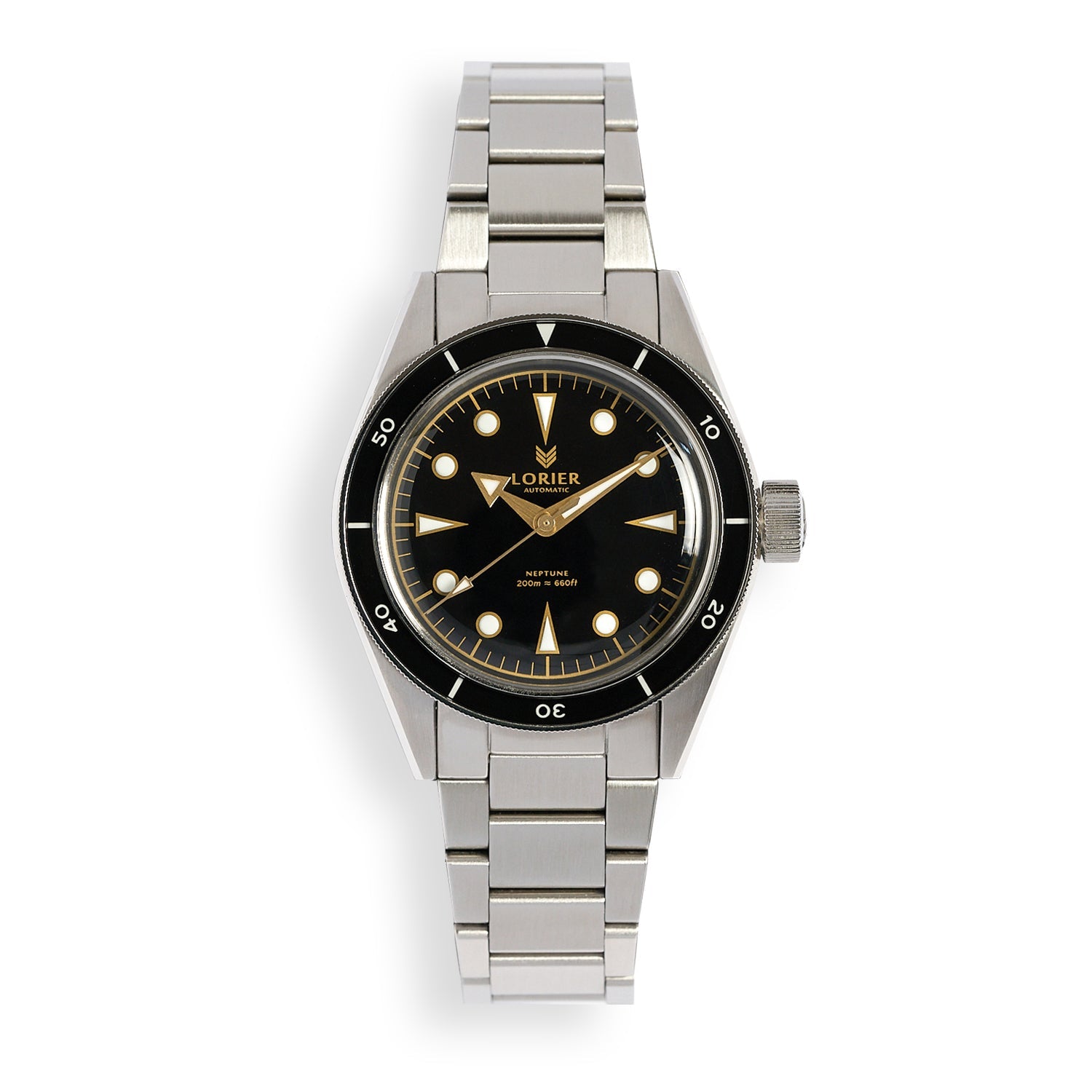
Hesalite crystal with a 2.4mm dome: the dome adds nearly a quarter-inch of visual height above the dial. Held at arm’s length, the crystal curves in a way that makes the black dial look deeper than a flat-crystal watch can achieve. The gilt indices catch light through the dome at angles that a flatter crystal eliminates. Lorier includes a tube of Polywatch in every box because they know Hesalite scratches, and because Polywatch polishes acrylic back to clear in two minutes. The ownership experience is different from sapphire. It is not worse. It is different.
Gilt indices and a glow-in-the-dark coating that glows blue: the gold applied markers and matching gold hands reference the radium-dial professional divers of the 1950s. The lume glows blue in the dark rather than the green that modern watches use. At 2am, the dial glows the color that vintage dive watches used before modern chemistry changed the standard. If you have seen a real 1960s diver in the dark, you know exactly what this looks like.
The dial is clean: no date window, just a black surface, eight gilt markers, center seconds hand, nothing competing for attention. The acrylic bezel insert, with its own luminous pip at 12 o’clock, rotates in one direction with 120 precise clicks.
Japanese automatic movement running at 28,800 beats per hour, faster than the standard 21,600 of most automatics at this price. The higher frequency means smoother seconds hand motion and slightly better accuracy. No date complication means one fewer thing to set and one fewer window in the dial.
Marine-grade stainless bracelet with solid end links: the links are secured by screw pins, which can be removed with the screwdriver Lorier includes in the box. The push-button clasp has five microadjustment positions so you can fit the bracelet without removing links for half-centimeter changes in wrist size.
Who this watch is for
You want a vintage dive watch, not a modern watch with vintage styling. The Neptune is not decorated with vintage details. It is built with the design language of 1959 as its starting point. The Hesalite, the gilt, the BGW9 lume: these are not aesthetic additions to a modern watch. They are the watch.
You care about the community behind the brand. Lorier makes small batches, communicates directly with buyers, and refines each series based on what owners tell them. The Neptune SIV is the result of three earlier versions and the feedback from the people who wore them.
You want 39mm done correctly. The SIV’s 46mm lug-to-lug is the result of deliberate refinement across multiple series. On most wrists, this is the size that looks right without the bulk that larger dive watches carry.
The honest flaw: the Hesalite crystal will scratch. This is not a flaw to minimize. It is the defining trade-off of the watch. If you want a crystal that does not scratch, the Neptune is the wrong watch. If you accept that scratches can be polished out and choose the aesthetic anyway, it is exactly the right one. The movement is Japanese, not Swiss, at a price where Swiss movements start appearing. And Lorier sells in small batches: when a run sells out, you wait for the next one, which can take months.
The BestWatchFor verdict
The Lorier Neptune SIV is for the person who wants a dive watch that looks genuinely vintage rather than nostalgic. The acrylic crystal, gilt indices, and blue-glowing lume are not compromises. They are the point. At $599 from a New York microbrand that builds in small batches, it is one of the few watches at this price that has a clear aesthetic conviction and commits to it completely.
Full Specifications (for the nerds)
- Case size
- 39mm
- Thickness
- 10.3mm
- Case material
- 316L stainless steel
- Crystal
- Hesalite
- Water resistance
- 200m (safe for swimming and diving)
- Movement
- Miyota 90S5
- Type
- automatic
- Power reserve
- 42 hours
- Lug-to-lug
- 46mm
- Strap width
- 20mm
- Bezel
- 120-click unidirectional
- Lume
- Super-LumiNova
- Strap/bracelet
- bracelet
- Clasp
- butterfly
- Dial color
- black
Ready to get yours?
We checked the prices so you don't have to. Here's where to buy the Lorier Neptune Series IV.